Why Your Website Stalls Without a Real Content Engine Behind It
Your website traffic has plateaued. Competitors are ranking higher for keywords you should own. The problem isn't your product—it's the absence of a systematic content engine that feeds your website consistently.
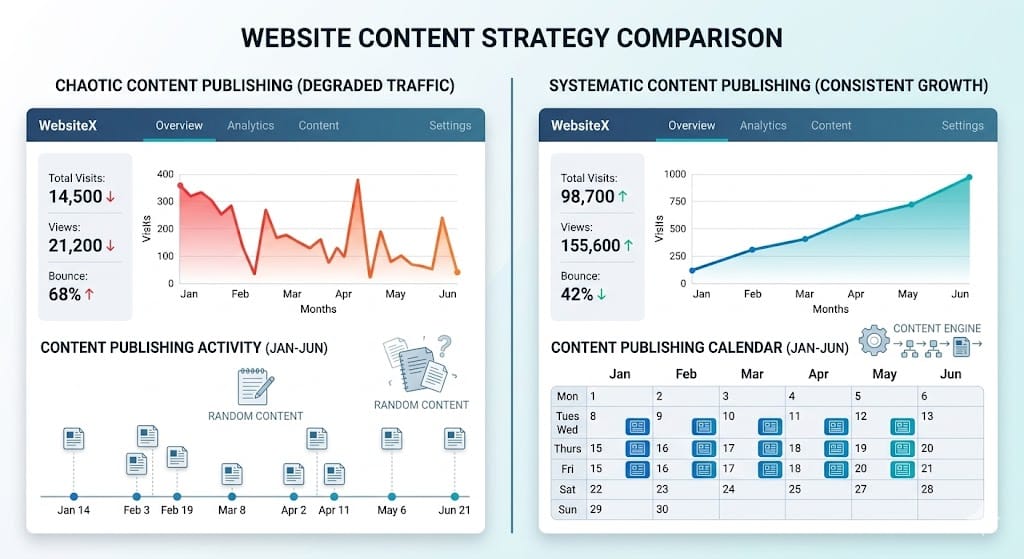
Your website traffic has plateaued. Engagement metrics show a slow decline. Competitors who started after you are ranking higher for keywords you should own.
The problem isn't your product, pricing, or positioning. It's the absence of a systematic content engine that feeds your website with consistent, valuable content.
Most teams recognize they need "more content" but miss the deeper issue. Without systematic content production, websites enter a slow decay cycle that's difficult to reverse once it starts.
This is why your website stalls and how to build the content engine that prevents it.
The Quiet Death of Websites That Ship Content "When We Can"
SEO Decay Happens Faster Than You Think
Search engines reward fresh, relevant content. When your publishing schedule becomes sporadic, your SEO foundation weakens incrementally.
Google's algorithm interprets infrequent updates as a signal that your site may be less relevant or authoritative. Your existing content gradually loses ranking position to competitors who publish consistently.
The decline isn't dramatic. You lose a few positions here and there. Traffic drops by small percentages each month. By the time you notice the pattern, you've lost significant ground that takes months to recover.
Visitor Trust Erodes Through Inconsistency
Website visitors develop expectations based on your content patterns. If your blog shows posts from three months ago as the most recent content, visitors question whether your business is active and growing.
This perception affects more than blog readership. Potential customers evaluate your company's reliability based on content freshness. Stale content suggests stagnant business operations.
The trust erosion extends to your email list and social media followers. When people don't see regular value from your content, they mentally categorize your brand as inactive, even if your business operations continue normally.
Team Demoralization From Content Chaos
Teams that produce content sporadically experience constant pressure and guilt. Every week without new content feels like falling behind. Team members know they should be creating content, but lack the systems to do it efficiently.
This creates a cycle where content creation becomes associated with stress rather than strategic progress. Team members avoid content tasks because they feel overwhelming and disorganized.
The demoralization affects content quality. When teams finally create content under pressure, they rush through research, writing, and optimization. The resulting content performs poorly, reinforcing the belief that content marketing doesn't work for their business.

What Actually Happens Inside Companies Without Content Systems
Last-Minute Content Scrambles
Without systematic content production, teams operate in a constant reactive mode. Someone realizes the blog hasn't been updated in weeks. A conference deadline approaches and they need thought leadership content. A competitor publishes something impressive and triggers panic about falling behind.
These scrambles produce predictable results: rushed research, shallow content, missed optimization opportunities, and team burnout. The content created during scrambles rarely performs well because it lacks the foundation that systematic production provides.
Quality Compromises Under Pressure
When content creation happens under deadline pressure, teams make compromises that undermine effectiveness. They skip keyword research, reduce editing time, and publish without proper internal linking or meta optimization.
These compromises aren't intentional quality reductions. They're survival mechanisms when teams lack time and systems to produce content properly. The resulting content fails to achieve business objectives, reinforcing the perception that content marketing requires too much effort for too little return.
Abandoned Content Initiatives
Companies without content systems start initiatives they can't sustain. They launch podcasts that stop after six episodes. They begin weekly newsletters that become monthly, then quarterly, then disappear entirely.
Each abandoned initiative damages team confidence and wastes the initial investment in setup, branding, and promotion. Teams become skeptical of new content projects because they've experienced multiple failures.
Hidden Context-Switching Costs
Ad-hoc content creation requires constant context switching. Team members shift between content tasks and their primary responsibilities without clear boundaries or dedicated time blocks.
This context switching reduces efficiency in both content creation and core business functions. Team members never develop content creation momentum because they approach it as an interruption rather than a systematic process.
The hidden cost extends beyond time. Context switching reduces content quality because creators can't maintain deep focus on research, writing, and optimization.
The Difference Between Random Acts of Content and a Real Engine
Systematic Processes vs. Creative Inspiration
A content engine operates on systematic processes rather than waiting for creative inspiration. It includes repeatable workflows for idea generation, research, creation, optimization, and promotion.
Random content creation depends on individual motivation and availability. Team members create content when they feel inspired or when external pressure demands it. This approach produces inconsistent output and quality.
Systematic content production removes dependence on inspiration. Teams follow established processes that generate ideas, guide research, and structure creation. Content quality becomes predictable because it follows proven frameworks rather than individual creativity alone.
Predictable Velocity vs. Sporadic Bursts
Content engines produce predictable output velocity. Teams know they'll publish specific amounts of content on defined schedules. This predictability enables better planning, resource allocation, and performance measurement.
Sporadic content creation produces bursts of activity followed by long gaps. Teams might publish three posts in one week, then nothing for a month. This inconsistency confuses audiences and undermines SEO performance.
Predictable velocity allows teams to build momentum. Each piece of content connects to previous and future content through internal linking, topic clusters, and audience development. Sporadic creation lacks these connections, reducing the compound value of content investments.
Compound Benefits from Consistency
Systematic content production creates compound benefits that sporadic creation cannot achieve. Each new piece of content builds on previous work through internal linking, topic authority development, and audience growth.
Search engines recognize consistent publishing patterns and reward them with better crawling frequency and ranking consideration. Social media algorithms favor accounts that post regularly. Email subscribers engage more with brands that provide consistent value.
These compound benefits take time to develop but create significant competitive advantages. Companies with content engines eventually outperform competitors with superior products but inferior content systems.
Building a Minimum Viable Content Engine for Lean Teams
Workflow Design for Sustainable Production
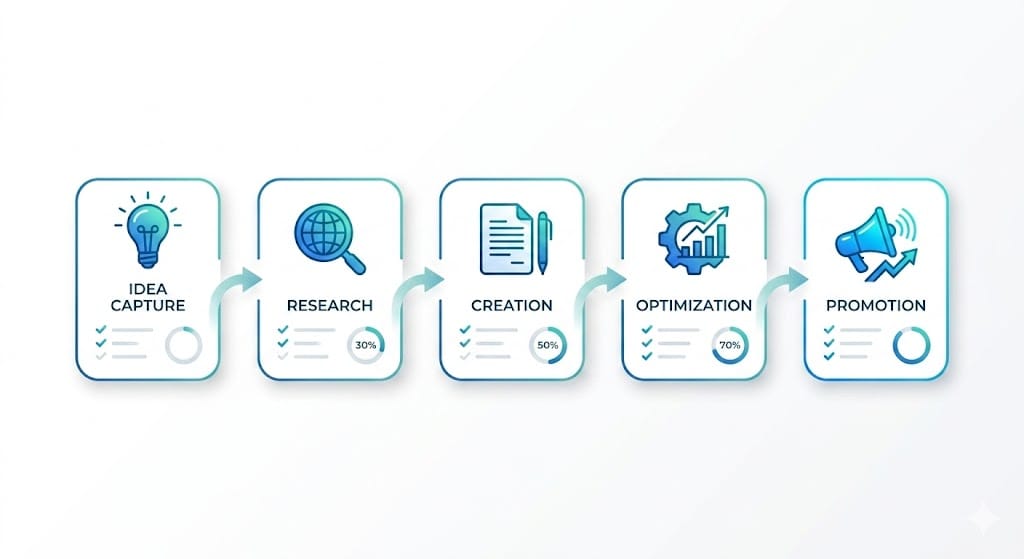
Start with a simple workflow that your team can execute consistently, rather than an elaborate system they'll abandon. The minimum viable content engine includes five components: idea capture, research process, creation workflow, optimization checklist, and promotion plan.
Idea capture prevents the "what should we write about" paralysis. Use a simple system like a shared document or basic project management tool to collect content ideas from team members, customer conversations, and industry observations.
The research process standardizes how you validate ideas and gather supporting information. This might include keyword research, competitor analysis, and internal data review. Keep the process simple enough to complete in 30-60 minutes per piece.
Creation workflow defines how content moves from idea to published post. Include clear handoffs between team members, quality checkpoints, and timeline expectations. Document the workflow so new team members can follow it without extensive training.
Tool Selection for Efficiency
Choose tools that integrate well and reduce friction in your content workflow. Avoid complex systems that require extensive setup or training. Focus on tools your team already uses or can learn quickly.
For most lean teams, a combination of Google Workspace, a simple project management tool like Trello or Asana, and your existing CMS provides sufficient functionality. Add specialized tools only when you've established consistent production with basic tools.
The key is reducing the number of tools and handoffs in your workflow. Each additional tool creates potential friction points that can derail consistent production.
Sustainable Pacing That Prevents Burnout
Set content production goals based on your team's actual capacity, not aspirational targets. It's better to publish one high-quality piece per month consistently than to aim for weekly publishing and fail after two months.
Consider your team's other responsibilities and seasonal workload variations. Build buffer time into your content calendar for unexpected business priorities or team member availability changes.
Start with a pace that feels almost too easy, then increase gradually as your team develops content creation efficiency. Sustainable pacing prevents the boom-and-bust cycles that kill content initiatives.
Quality Standards That Scale
Establish minimum quality standards that ensure every piece of content meets your brand requirements without creating perfectionist paralysis. These standards should cover research depth, writing quality, SEO optimization, and brand voice consistency.
Document these standards in a simple checklist that team members can follow during creation and review. Include examples of content that meet your standards so team members understand expectations clearly.
Quality standards should be achievable with your current team's skills and available time. You can raise standards gradually as your team develops content creation expertise.
The Compound Effect: What Changes When Content Becomes Systematic
Traffic Patterns Shift from Decline to Growth
Systematic content production reverses the SEO decay that affects websites with sporadic publishing. Search engines begin recognizing your site as an active, authoritative source in your industry.
The traffic growth isn't immediate. You'll typically see initial improvements after 3-4 months of consistent publishing, with significant growth becoming apparent after 6-12 months. The key is maintaining consistency through the initial period when results aren't yet visible.
Traffic quality improves alongside quantity. Systematic content production allows you to target specific keywords and topics strategically, attracting visitors who are more likely to become customers.
Lead Quality Improves Through Strategic Targeting
Content engines enable strategic topic selection that attracts your ideal customers. Instead of creating random content, you can systematically address the questions and challenges your best customers face.
This strategic approach improves lead quality because visitors who find your content through search are actively seeking solutions you provide. They arrive with higher intent and better qualifications than visitors from general marketing campaigns.
The improvement in lead quality often matters more than the increase in lead quantity. Better-qualified leads convert at higher rates and require less sales effort to close.
Team Confidence Builds Through Consistent Success
Teams that operate content engines develop confidence in their content marketing capabilities. They see predictable results from systematic efforts, which motivates continued investment and improvement.
This confidence enables teams to tackle more ambitious content projects and experiment with new formats or channels. They have a foundation of successful content production that supports expansion efforts.
Team confidence also improves content quality. When team members trust their content process, they focus on optimization and improvement rather than basic execution survival.
Business Outcomes Become Predictable
Systematic content production makes business outcomes more predictable. Teams can forecast traffic growth, lead generation, and customer acquisition based on content production levels and historical performance.
This predictability enables better business planning and resource allocation. You can invest in content production with confidence because you understand the expected returns.
Predictable outcomes also make it easier to justify content marketing investments to stakeholders who prefer measurable, systematic approaches over creative initiatives with uncertain returns.
Building Your Content Engine
Your website doesn't need more random content. It needs systematic content production that builds momentum over time.
The difference between companies that succeed with content marketing and those that struggle isn't creativity or budget. It's the presence of systematic processes that turn content creation from an occasional activity into a predictable business function.
Start with the minimum viable content engine: simple workflows, basic tools, sustainable pacing, and clear quality standards. Build consistency before complexity.
Your content engine will become a competitive advantage that's difficult for competitors to replicate because it's built on operational discipline rather than individual talent or large budgets.
Ready to diagnose what's missing from your current content approach and build a systematic engine that actually works? We help teams identify content production bottlenecks and design minimum viable engines that fit their resources and goals. Contact us for a content operations audit that reveals specific gaps in your current system and provides a practical roadmap for systematic content production.