Why Most Businesses Don't Need More Content. They Need a Publishing System
Your content team is drowning in creation but starving for systems. Most businesses focus on volume over infrastructure, treating each piece as a custom project. The solution isn't more content—it's publishing systems that transform scattered effort into operational infrastructure.

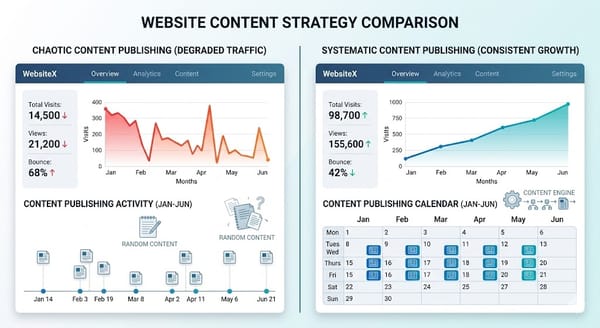
Your content team is drowning. Every week brings new pressure to publish more blog posts, create more social media updates, and produce more videos. Yet despite all this effort, your content feels scattered, your audience engagement remains flat, and your team burns out faster than they can produce.
The problem isn't that you need more content. The problem is that you're treating content like a creative exercise instead of an operational system.
Most businesses approach content backwards. They focus on creation—brainstorming topics, writing articles, designing graphics—while completely ignoring the infrastructure that turns content from a time sink into a business asset. They build content libraries without building content systems.
A content publishing system is different. It's the operational backbone that takes your content from conception to distribution to measurement, with clear workflows, defined handoffs, and automated processes that work whether you're feeling inspired or not.
For education providers managing course launches, exam-prep businesses building authority, and lean SaaS teams competing for attention, this distinction matters more than you might think. The companies that scale their content impact aren't necessarily creating more—they're publishing smarter.
The Content Volume Trap: Why More Isn't Working
The "more content" mindset feels logical. If one blog post brings some traffic, ten should bring ten times more. If posting once a week generates leads, posting daily should generate more leads.
This thinking breaks down quickly in practice.
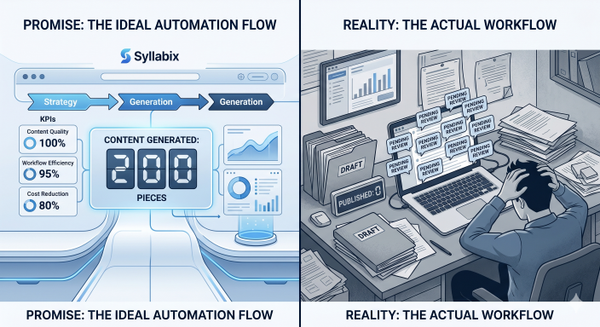
When you focus on volume without systems, every piece of content becomes a custom project. Your team reinvents the wheel for each blog post, scrambles to find images for each social update, and manually distributes each piece across different channels. The cognitive load compounds with every additional piece you create.
Education businesses feel this acutely. You might create excellent course content, but when it comes to marketing that content, you're starting from scratch each time. One week, you write a detailed blog post about exam strategies. Next week, you create a social media series about study techniques. The week after that, you produce a video about test anxiety. Each piece lives in isolation, requiring separate planning, separate creation, and separate distribution.
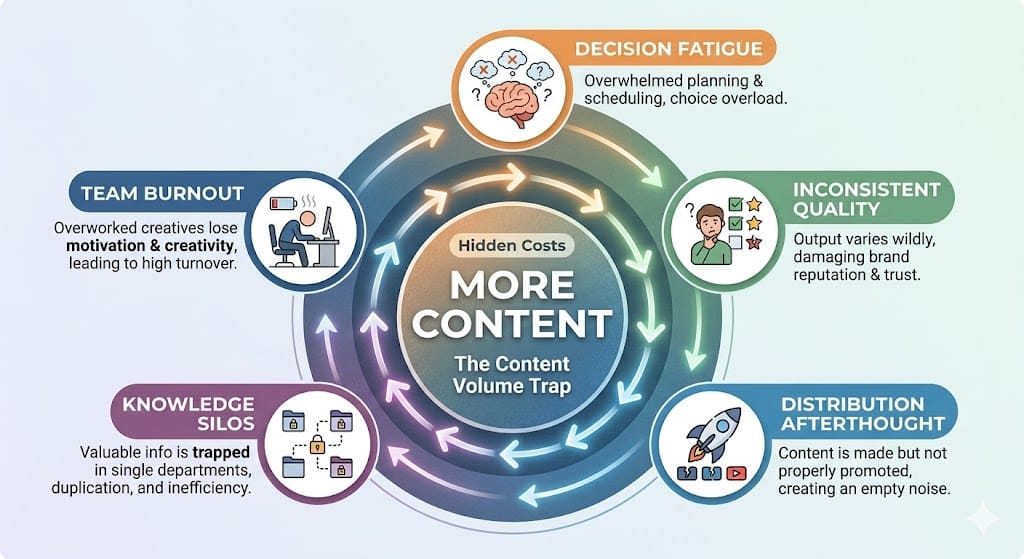
The hidden costs accumulate:
Decision fatigue multiplies. Without templates or workflows, every content decision—from topic selection to image choice to distribution timing—requires mental energy. Your team spends more time deciding what to create than actually creating it.
Quality becomes inconsistent. When each piece is a one-off project, some content gets your full attention, while other pieces get rushed. Your audience notices the inconsistency, even if you don't.
Distribution becomes an afterthought. You spend 80% of your time creating content and 20% distributing it, when the impact ratio should be reversed. Great content that reaches ten people generates less business value than good content that reaches a thousand.
Knowledge stays trapped in individual heads. When your content process depends on specific people remembering specific steps, you can't scale. Team members become bottlenecks, and knowledge walks out the door when people leave.
For SaaS teams especially, this creates a compounding problem. You need consistent content to build authority in your niche, but you also need to ship product features. When content creation feels chaotic and time-intensive, it gets deprioritized. You end up in a cycle where you create content in bursts, then abandon it for weeks while focusing on product work.
The volume trap convinces you that the solution is more content, when the real solution is better systems.
What a Content Publishing System Actually Is (And Why It's Different)
A content publishing system isn't a content calendar. It's not a list of blog post ideas or a social media scheduling tool. It's the operational infrastructure that moves content from concept to impact with minimal friction and maximum consistency.
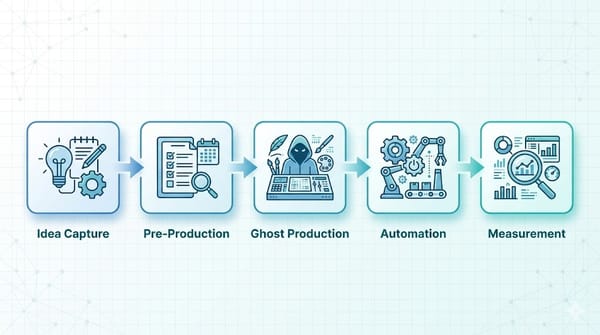
Think of it like a manufacturing line, but for content. Raw materials (ideas, research, feedback) enter one end. Finished products (published articles, distributed social posts, measured results) come out the other end. The system handles the transformation.
Most businesses have content calendars. Few have content systems.
A content calendar tells you what to publish when. A content publishing system tells you how to move from idea to publication, who handles each step, what templates to use, how to maintain quality, and how to measure success. The calendar is a planning tool. The system is an operational infrastructure.
Here's the difference in practice:
Content calendar approach: "We need a blog post about exam anxiety for next Tuesday. Sarah, can you write something? Make it around 1,500 words. We'll figure out images later. Don't forget to post it on social media."
Publishing system approach: Sarah opens the blog post template, follows the research workflow to gather supporting data, uses the established writing framework, selects images from the pre-approved library, schedules distribution across all channels using the automation setup, and adds the performance tracking tags that feed into the monthly content report.
The system removes decisions, reduces errors, and creates consistency. More importantly, it makes content creation scalable. When Sarah goes on vacation, anyone can follow the same system and produce similar results.
For education providers, this distinction transforms how you approach content marketing. Instead of creating one-off blog posts about different topics, you develop content series that build on each other. Your system might include templates for course announcement posts, student success stories, and industry trend analysis. Each template includes research prompts, writing frameworks, image specifications, and distribution checklists.
The system thinking extends beyond individual pieces. Your content publishing system connects content to business outcomes. It includes feedback loops that tell you which content drives course enrollments, which topics generate the most engagement, and which distribution channels deliver the best ROI.
This is why publishing systems transform content from a cost center into a business asset. Instead of spending money to create content that may or may not work, you're investing in infrastructure that consistently produces measurable results.
Four Components Every Publishing System Needs
Every effective content publishing system includes four core components: content planning framework, production workflows, distribution automation, and performance feedback loops. Each component serves a specific function, and they work together to create the operational backbone for consistent content output.
Content Planning Framework
This isn't a content calendar. It's the decision-making structure that determines what content to create, when to create it, and how it connects to business goals.
For exam-prep businesses, your planning framework might organize content around the academic calendar. You know that test anxiety content performs best in the months leading up to major exams. Study technique content works year-round but peaks during back-to-school seasons. Your framework maps these patterns and creates content clusters that build on each other.
The framework includes content templates for different business functions. Course launch content follows one template. Student success stories follow one another. Industry analysis pieces follow a third. Each template specifies the research required, the key points to cover, and the call-to-action that aligns with business goals.
Lean SaaS teams benefit from frameworks that connect content to product releases and customer feedback. Your framework might include templates for feature announcement posts, customer case studies, and industry trend analysis. Each template connects to specific business metrics—feature adoption rates, customer retention, or lead generation.
Production Workflows
These are the step-by-step processes that move content from idea to publication. Good workflows specify who does what, when they do it, and what tools they use. They eliminate the decision fatigue that slows down content creation.
A typical blog post workflow might include: research phase (gather data, interview sources, collect examples), writing phase (create outline, write first draft, internal review), production phase (edit, design graphics, optimize for SEO), and publication phase (schedule post, prepare social media, set up tracking).
Each phase includes specific deliverables and handoff points. The research phase produces a brief with key points, supporting data, and target keywords. The writing phase produces a completed draft that meets length and style requirements. The production phase produces a publication-ready post with optimized images and metadata.
For education businesses managing multiple content types, workflows prevent things from falling through the cracks. Your course announcement workflow might include steps for creating the main blog post, extracting social media content, preparing email newsletter sections, and updating relevant landing pages. Each step has an owner and a deadline.
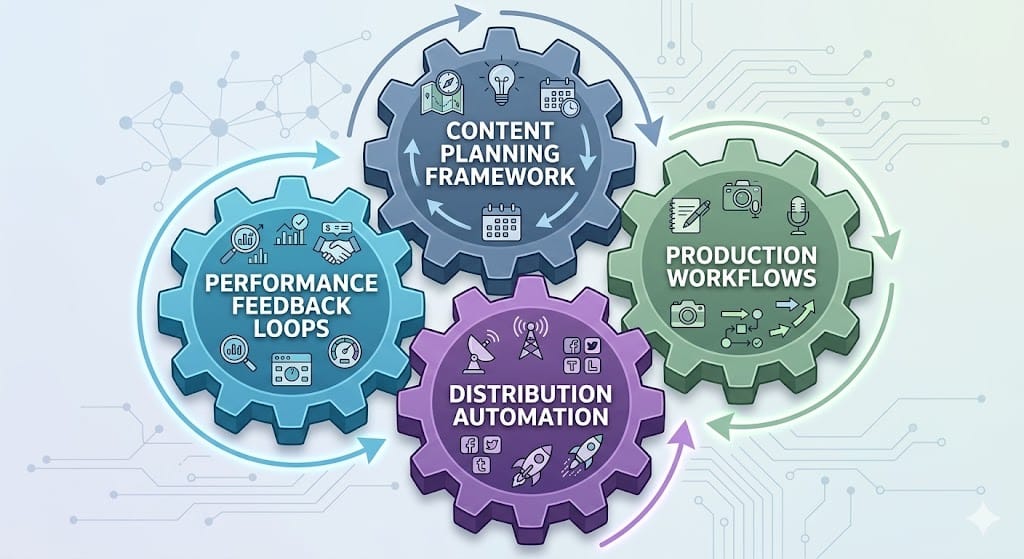
Distribution Automation
This component ensures your content reaches your audience consistently across all relevant channels. It includes both the technical automation (scheduling tools, RSS feeds, social media integrations) and the process automation (checklists, templates, approval workflows).
The goal isn't to automate everything, but to automate the repetitive tasks that don't require human judgment. Your system might automatically cross-post blog content to LinkedIn, send new posts to your email list, and update your content archive. It might also include templates for manual tasks like creating platform-specific social media posts or reaching out to industry contacts for content amplification.
For service-based businesses, distribution automation often includes client communication workflows. When you publish a new case study, your system might automatically notify relevant clients, add the content to your sales materials library, and schedule social media posts that tag the featured client.
Performance Feedback Loops
This component measures content performance and feeds insights back into your planning framework. It answers questions like: Which content drives the most business results? Which topics resonate most with your audience? Which distribution channels deliver the best ROI?
The feedback loops include both quantitative metrics (traffic, engagement, conversions) and qualitative insights (customer feedback, sales team input, support ticket trends). They operate on different time scales, weekly performance reviews, monthly trend analysis, and quarterly strategy adjustments.
For exam-prep businesses, feedback loops might track which content correlates with course enrollments, which topics generate the most student questions, and which formats (blog posts, videos, infographics) drive the most engagement. This data feeds back into your content planning framework, helping you double down on what works and eliminate what doesn't.
The key is connecting content metrics to business metrics. Page views matter less than lead generation. Social media engagement matters less than customer retention. Your feedback loops should track the metrics that actually impact your business goals.
Building Your First Publishing System: A 30-Day Roadmap
Building a content publishing system doesn't require months of planning or expensive tools. You can create a functional system in 30 days by focusing on one content type and gradually expanding the infrastructure.
Week 1: Audit and Document Current State
Start by documenting exactly how you currently create and distribute content. Map out every step from idea generation to performance measurement. Include who's involved, what tools you use, and where things typically get stuck.
Most businesses discover they have more processes than they realized—it's just not documented or consistent. You might find that Sarah always researches topics using the same three sources, but this knowledge exists only in her head. Or that your social media posts perform better when they include specific types of images, but no one has written down the pattern.
Create a simple process map for your most common content type. If you primarily publish blog posts, map out the blog post process. If you focus on social media, map out the social media process. Don't try to optimize yet, just document what actually happens.
Identify the biggest friction points. Where do projects typically get delayed? Which steps require the most back-and-forth communication? Which tasks get forgotten or done inconsistently? These friction points will become your optimization priorities.
Week 2: Choose Your First Content Type and Create Templates
Pick one content type to systematize first. Choose something you create regularly, and that has a clear business impact. For most businesses, this will be blog posts, but it might be social media content, email newsletters, or video scripts.
Create templates for this content type. A blog post template might include sections for headline options, target keywords, outline structure, research sources, and call-to-action options. The template should reduce decision-making without constraining creativity.
Build supporting templates for related tasks. If you're systematizing blog posts, create templates for social media promotion, email newsletter inclusion, and performance tracking. Each template should specify what information to include and how to format it.
Test your templates by creating one piece of content using the new structure. Note what works well and what needs adjustment. Templates should feel helpful, not restrictive.
Week 3: Build Your Production Workflow
Document the step-by-step process for moving content from a template to publication. Specify who handles each step, what deliverables they produce, and when they hand off to the next person.
Create checklists for each major phase. A writing phase checklist might include: research completed, outline approved, first draft written, internal review requested, and revisions incorporated. Checklists prevent steps from being skipped and make it easier for team members to cover for each other.
Set up your basic tool stack. You don't need expensive software—Google Docs, Trello, and Buffer can handle most small business publishing systems. The key is choosing tools that integrate well and that your team will actually use.
Test your workflow by producing one complete piece of content from start to finish. Time each phase and note where things get stuck. Adjust the workflow based on what you learn.
Week 4: Add Distribution and Measurement
Set up your distribution channels and create templates for each platform. Your blog post might automatically feed to LinkedIn, but you'll need templates for Twitter threads, Instagram posts, and email newsletter sections.
Implement basic performance tracking. Set up Google Analytics goals for content-driven conversions. Create a simple spreadsheet to track which content generates the most engagement, leads, or sales. You can sophisticate this later, but start with basic measurement.
Create your feedback loop process. Schedule weekly 15-minute reviews to look at content performance. Schedule monthly 30-minute sessions to identify trends and adjust your content planning. Schedule quarterly 60-minute sessions to evaluate and improve your entire system.
Run your complete system for one full content cycle. Create, distribute, and measure one piece of content using all your new templates and workflows. Document what works and what needs improvement.
Beyond 30 Days: Scale and Optimize
Once your first content type is systematized, you can expand to other content types using the same framework. Each new content type will be faster to systematize because you'll have established templates and workflows to adapt.
Focus on automation opportunities. Look for repetitive tasks that don't require human judgment and find ways to automate them. This might mean setting up RSS feeds, using scheduling tools, or creating email templates.
Continuously optimize based on performance data. Your content publishing system should evolve as you learn what works for your audience and business. The goal isn't to create a perfect system immediately, but to create a system that improves consistently over time.
Transform Content from Cost to Asset
Most businesses treat content creation like an expense—something that costs time and money without guaranteed returns. Publishing systems transform content into a business asset—infrastructure that consistently generates measurable value.
The shift requires thinking like an operator instead of a creator. Instead of asking "What should we write about?" you ask "What system will consistently produce content that drives business results?" Instead of measuring success by content volume, you measure success by business impact.
For education providers, exam-prep businesses, and lean SaaS teams, this operational approach to content creates sustainable competitive advantages. While competitors scramble to create more content, you're building systems that create better content more efficiently.
Your content publishing system becomes a business asset that appreciates over time. Each piece of content you create strengthens the system. Each optimization improves all future content. Each team member who learns the system increases your content capacity without increasing your content chaos.
Ready to transform your content from scattered effort into systematic results? Request a publishing system audit, one to identify your biggest workflow gaps and get a customized roadmap for building content infrastructure that actually works for your business.